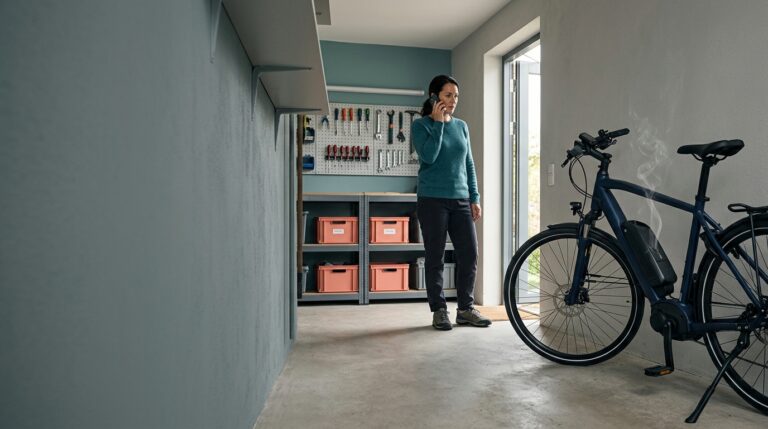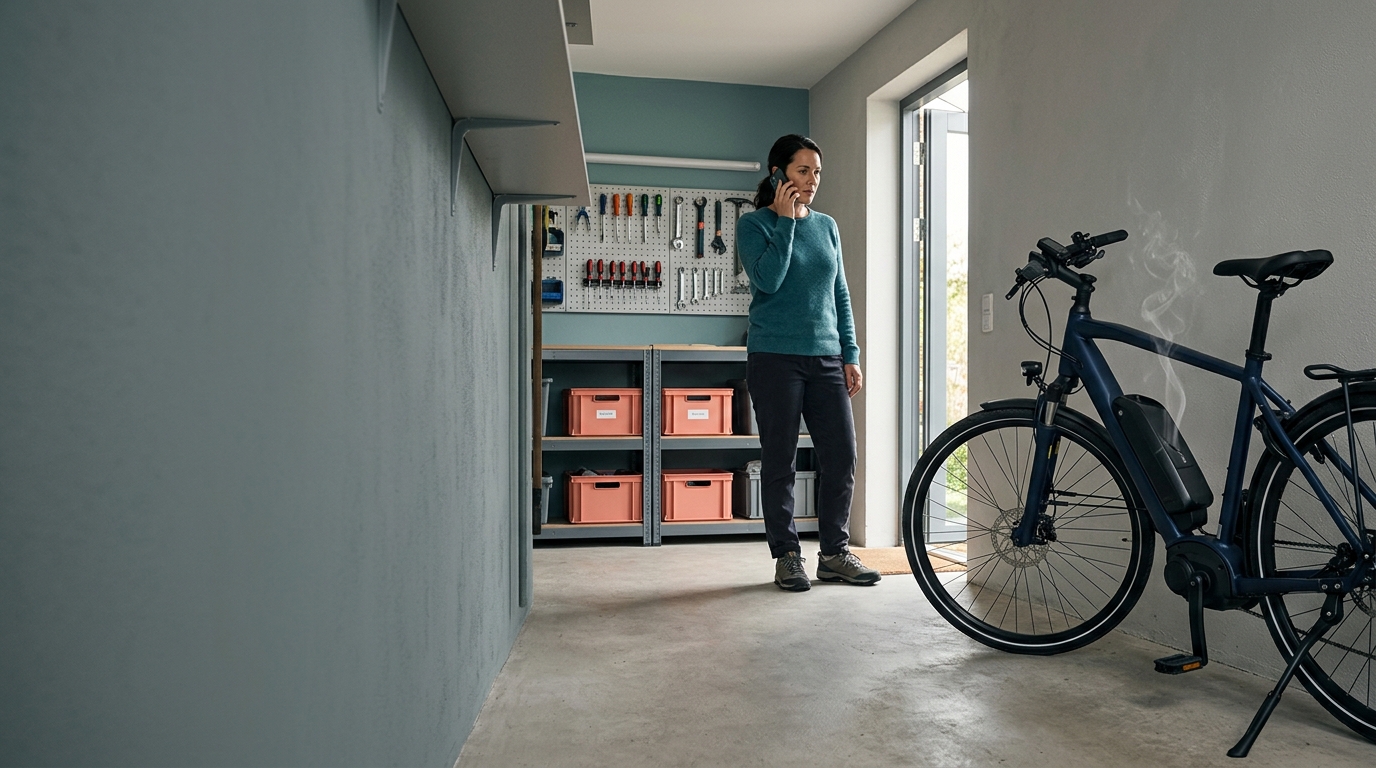
The U.S. Consumer Product Safety Commission reported 19 e-bike fatalities associated with lithium-ion battery fires from 2017 through 2024. In June 2026, the agency approved publication of a proposed mandatory safety standard intended to address thermal runaway, fire, and explosion hazards in micromobility batteries. Recent product warnings also show why owners should check recalls and stop using batteries named in official safety notices rather than waiting for visible damage.
This guide explains the warning signs of battery failure, emergency steps, burn and smoke-inhalation concerns, evidence preservation, safer charging, recall checks, and disposal.
Emergency warning: If an e-bike battery is smoking, hissing, popping, releasing gas, sparking, burning, or rapidly overheating, evacuate immediately and call emergency services. Do not block your exit, re-enter for the battery, or attempt to carry a burning device through a building.
Recognize Battery Trouble and Act Before the Fire Spreads
Battery problems do not always begin with visible flames. Warning signs may appear during charging, after a crash, following water exposure, or after a repair. Treat a dropped, crushed, punctured, opened, rebuilt, or mismatched battery cautiously even when the e-bike still operates.
Identify Warning Signs and Immediate Fire Risks
Stop using a battery that changes, leaks, smells, or makes unusual sounds
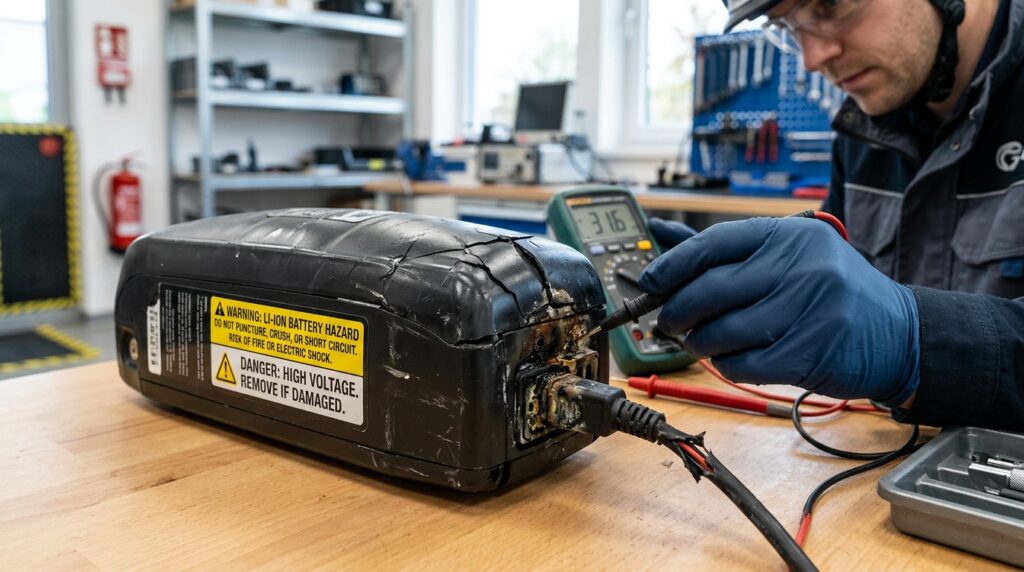
Watch for swelling, cracking, leaking, discoloration, melted connectors, damaged wiring, or a case that no longer fits correctly. Other danger signs include an unusual odor, hissing, popping, excessive heat, smoke, sparks, or an abnormally hot charger. Sudden power loss, repeated shutdowns, or unexplained errors may also require inspection.
Stop riding and charging when any of these conditions appears. Disconnect the charger only when it is safe, keep people away, and follow manufacturer or fire-authority guidance. Do not open the battery, repair individual cells, or test it by charging again.
If the battery is hot, venting, smoking, or making escalating noises, do not handle it. Move away, close doors behind you when leaving, warn others, and call emergency services. Fire conditions can change quickly, and damaged lithium-ion batteries may reignite after visible flames disappear. Leave assessment and removal to trained responders.
Evacuate first, then address burns and smoke exposure
During an active battery fire, life safety comes before property. Use the nearest safe exit and avoid routes blocked by the e-bike, charger, smoke, or flames. Alert everyone in the home or workplace, activate the fire alarm when available, and call emergency services from a safe location. Tell the dispatcher that an e-bike or lithium-ion battery is involved.
Do not rely on a small household extinguisher or improvised method to make the area safe. The U.S. Fire Administration advises the public not to try to put out a lithium-ion battery fire; instead, evacuate and call 911. Follow instructions from emergency dispatchers and firefighters, and do not re-enter until authorities say it is safe.
For a thermal burn, move away from the heat and cool the skin with cool running water when practical. Remove rings or tight items before swelling, but do not pull away material stuck to the skin. Do not apply ice or household remedies. Cover loosely with a clean dressing and seek medical care for deep, large, facial, hand, foot, joint, genital, or airway burns.
Smoke and battery gases can also cause injury. Seek emergency help for coughing, wheezing, chest tightness, confusion, dizziness, soot around the mouth or nose, hoarseness, facial burns, or difficulty breathing. Symptoms may worsen after the person leaves the scene, so medical evaluation may be necessary even when visible burns appear limited.
Check Recalls and Preserve Evidence After the Emergency
Record the product, charger, purchase, and incident before disposal
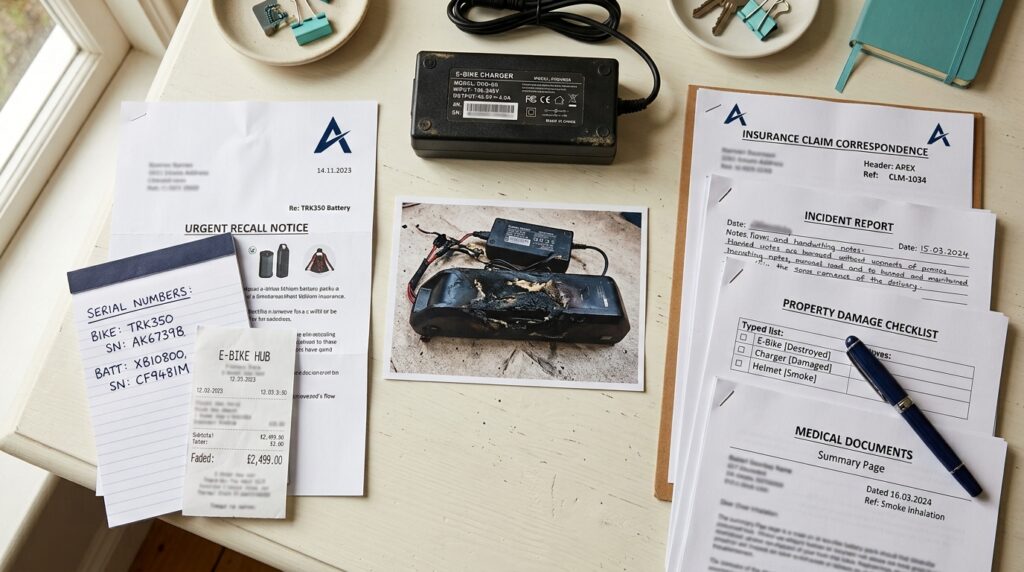
Once emergency officials have released the scene, document the e-bike, battery, charger, and surroundings without touching unsafe debris. Photograph the make, model, serial number, battery label, voltage, capacity, charger label, connectors, damage, burn patterns, smoke alarms, outlet, extension cords, and charging location. Save the purchase receipt, order confirmation, product listing, manual, warranty, repair records, and communications with the seller or manufacturer.
Write a timeline covering when the battery was last used, charged, dropped, repaired, exposed to water, or paired with another charger. Record the first odor, heat, noise, smoke, or flame, the bike’s position, and the emergency response. Preserve medical records, injury photographs, property-loss records, insurance correspondence, and witness contacts.
Check official recall and product-warning databases using the exact model and serial information. A recall may involve only certain production dates, battery capacities, chargers, or model numbers. Follow the remedy stated in the notice. Some warnings instruct owners to stop use immediately, remove the battery if safe, and contact a hazardous-waste facility rather than using ordinary recycling bins.
Do not sell, donate, ship, or place a recalled or defective battery in household trash. Damaged batteries may require different handling from ordinary used batteries. Call the local household hazardous-waste facility before transporting the device and explain that the battery is damaged, recalled, swollen, overheated, or involved in a fire. Follow instructions from fire officials, the municipality, manufacturer, and insurer.
Reduce Charging Risks and Make Safer Ownership Decisions
Not every battery incident can be predicted, but owners can reduce avoidable risk by using compatible equipment, protecting exits, inspecting the device, and refusing questionable repairs or replacement packs. Safety should take priority over faster charging, longer range, or a low-cost battery advertised as universally compatible.
Use Compatible Equipment and a Safer Charging Routine
Choose e-bikes, batteries, and chargers from reputable sellers and look for certification by a nationally recognized testing laboratory. Certification does not remove all risk, but it shows evaluation against applicable requirements. Avoid listings with questionable logos, no traceable manufacturer, weak support, or implausibly cheap high-capacity batteries.
Use only the battery and charger specified by the manufacturer. Matching the plug is not enough; voltage, current, charging communication, battery-management systems, and connector design matter. Avoid so-called universal chargers unless the device manufacturer has expressly approved the exact model. Do not combine battery packs, bypass safety controls, replace cells at home, or use a pack assembled from unknown or salvaged cells.
Charge in a cool, dry, ventilated location away from beds, sofas, curtains, paper, fuel, and other combustible materials. Keep the e-bike and charger away from doors, stairways, corridors, and fire escapes so a failure cannot block the way out. Plug the charger directly into a suitable wall outlet rather than a damaged extension cord, overloaded power strip, or chain of adapters. Stop charging when complete and avoid leaving the device charging unattended or while everyone is asleep.
Inspect the battery, charger, cable, and outlet before each charge. Do not charge a battery that is wet, damaged, swollen, unusually hot, recalled, or recently involved in a significant crash. After water exposure, follow manufacturer guidance instead of assuming that drying the exterior makes the battery safe. Repairs should be performed by a qualified service provider using approved parts.
Buy carefully, charge visibly, and keep the exit clear
Install and test smoke alarms, plan escape routes, and make sure no one moves a failing battery through occupied rooms. Apartments, workplaces, and delivery operations should define charging, damaged-device reporting, storage, and emergency procedures.
For current warnings, recall links, and safety information, visit the CPSC Micromobility Information Center. Report unsafe products and incidents through the official reporting channels listed there.
Readers can also review Injory’s e-bike and e-scooter accident guide, product and technology risk library, recovery and rehabilitation resources, and injury documentation guide. These resources can help organize medical, insurance, property, and product records after a fire or injury.
An e-bike battery that smells unusual, changes shape, leaks, makes odd noises, overheats, or emits smoke should never be ignored. Stop use, protect the exit, and call emergency services when a dangerous condition develops. After the emergency, preserve product information, check official recalls, obtain medical care, and follow hazardous-waste instructions. Safer charging habits cannot eliminate every defect, but they can reduce preventable exposure and give people more time to escape.
This article provides general educational information and is not medical, firefighting, engineering, product-safety, insurance, or legal advice. Follow emergency dispatcher and fire-department instructions during a battery incident. Recall remedies, disposal rules, building codes, and legal deadlines vary by product and jurisdiction.