
The U.S. Consumer Product Safety Commission reports that emergency-department-treated injuries and deaths associated with micromobility products are increasing. Its latest micromobility research also examines recurring hazards involving paved roads, motor vehicles, visibility, helmet use, and higher riding speeds. This guide explains the practical steps to take after an e-bike or e-scooter crash, the evidence worth preserving, and the warning signs that should not be ignored.
Emergency note: Call emergency services immediately when anyone has severe bleeding, breathing difficulty, loss of consciousness, worsening confusion, repeated vomiting, seizure activity, weakness, numbness, major deformity, or intense head, neck, back, chest, or abdominal pain.
What to Do Immediately After an E-Bike or E-Scooter Crash
The first minutes after a collision can feel chaotic. Focus on safety and health before worrying about blame, insurance, repair costs, or online accounts. A clear sequence can reduce additional danger and preserve information that may become important later.
Move to Safety, Check for Injuries, and Report the Crash
Protect the scene without creating another hazard
Stop riding and move out of active traffic when you can do so safely. Do not drag or force someone to stand if they may have a head, neck, spine, hip, or serious leg injury. Turn on hazard lights, use a flashlight, or ask another person to warn approaching traffic. If a damaged battery is smoking, hissing, swelling, leaking, unusually hot, or burning, move away from it and call emergency services. Do not touch a burning lithium-ion battery or carry it into a building or vehicle.
Check yourself and other people involved. Adrenaline can temporarily mask pain, so look for bleeding, confusion, difficulty speaking, uneven pupils, weakness, numbness, deformity, and problems with balance. A helmet can reduce some risks, but it does not rule out a concussion or other injury.
Call the police or appropriate local authority when the crash involves a motor vehicle, pedestrian, significant injury, suspected intoxication, a hit-and-run, damaged public property, or a dispute about what happened. Ask how to obtain the incident or crash report. If an officer does not attend, find out whether your jurisdiction permits an online or self-filed report.
Get timely medical attention and follow discharge instructions
Emergency care is appropriate for serious symptoms. For less obvious injuries, consider a prompt medical evaluation, especially after a head impact, hard fall, collision with a vehicle, or increasing pain. Tell the clinician exactly how the crash happened: the estimated speed, direction of impact, whether your head hit anything, whether you lost consciousness, and which body parts absorbed the force.
Symptoms can evolve. Headache, dizziness, nausea, light sensitivity, brain fog, irritability, neck stiffness, or unusual fatigue may appear later. Review our planned guide to concussion warning signs after a crash, and seek urgent care when symptoms worsen. Follow medication, activity, follow-up, and return-to-work or return-to-riding instructions. Skipping recommended care can make recovery harder and create gaps in the medical record.
Document the Scene, the Device, and Every Involved Party
Capture details before they disappear
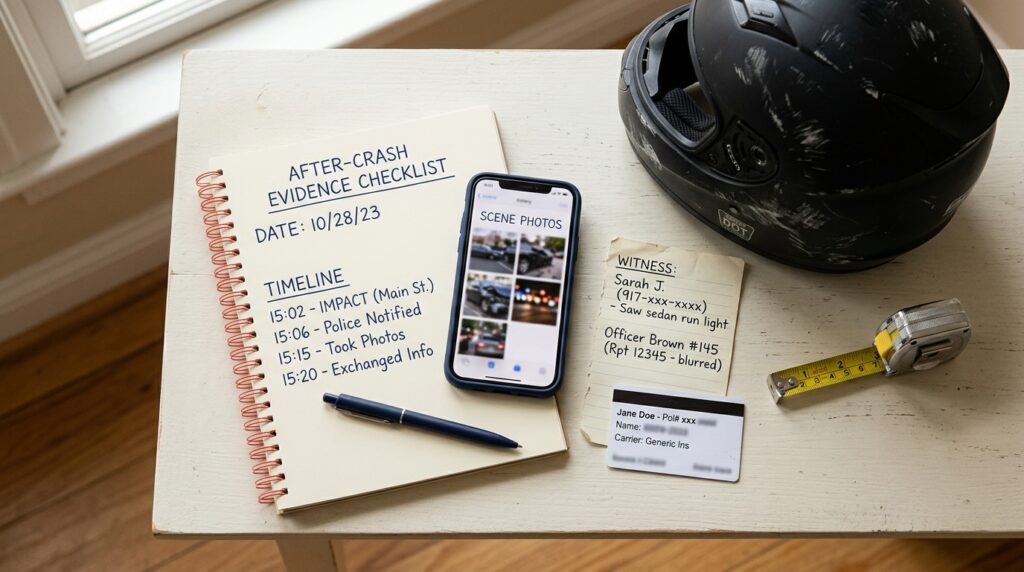
When it is safe, take wide and close photographs or video. Record the final positions of the scooter, bicycle, vehicles, and debris. Include traffic signals, signs, crosswalks, bike lanes, potholes, construction plates, loose gravel, wet surfaces, blocked sightlines, skid marks, lighting, and weather. Photograph visible injuries and damaged clothing, helmet, phone, backpack, and safety equipment.
Collect names, phone numbers, email addresses, driver’s-license details, vehicle registration, insurance information, and license-plate numbers. Ask witnesses for contact information instead of relying on a promise that they will remain nearby. Note nearby homes, shops, buses, traffic cameras, doorbell cameras, and parking facilities that may have recorded the crash. Video can be overwritten quickly, so send a written preservation request as soon as practical or ask a licensed attorney about the proper process.
If the device was rented, screenshot the entire trip record: operator name, vehicle identification number, reservation time, route, start and end points, charges, messages, reported defects, and support tickets. Save the rental agreement and current version of the app terms. Do not rely on the app to retain everything indefinitely.
Preserve the e-bike or scooter in its post-crash condition
Do not immediately repair, discard, charge, reset, or dismantle a device that may have malfunctioned. A failed brake, loose handlebar, damaged tire, throttle problem, software issue, or battery defect may require inspection. Store the device in a safe location that follows battery-safety guidance. If there is a fire or overheating risk, contact emergency services, the manufacturer, or a qualified battery professional rather than placing it inside a home.
Photograph the make, model, serial number, battery label, charger, warning labels, modifications, and any error messages. Save purchase receipts, maintenance records, prior complaints, recall notices, and communications with the seller, rental company, repair shop, or manufacturer. Check the CPSC Micromobility Information Center for current safety information and recall resources.
Protect Your Recovery, Records, and Future Decisions
The crash scene is only the beginning. Medical progress, missed work, transportation costs, device data, and insurance communications can become difficult to reconstruct weeks later. A simple system helps you stay organized without turning recovery into a full-time administrative job.
Build a Clear Timeline and Communicate Carefully
Create one folder—digital, physical, or both—for every crash-related record. Start a timeline with the date, time, location, route, weather, lighting, and a neutral description of what occurred. Add medical visits, diagnoses, prescriptions, referrals, work restrictions, symptom changes, repair estimates, and communications. Keep receipts for treatment, medication, mobility aids, replacement transportation, damaged property, childcare, and other crash-related expenses.
Maintain a brief daily symptom log. Record pain levels, sleep, headaches, dizziness, concentration, mobility, emotional changes, activities you could not complete, and assistance you needed. Be accurate rather than dramatic. Consistent notes can help clinicians understand patterns and help you remember details during later conversations.
Avoid common insurance and social-media mistakes

Notify the appropriate insurer promptly, but do not guess about facts you do not remember. Depending on the situation, possible coverage may involve an auto policy, homeowner or renter policy, health insurance, a commercial policy, an employer policy, or coverage connected to a rental operator. Coverage rules vary widely by location and policy wording.
Before giving a recorded statement or signing a broad authorization, understand who is requesting it, what it covers, and whether a deadline applies. Keep copies of everything you submit. A quick settlement may not account for symptoms that are still developing, future treatment, lost income, or a disputed device defect.
Limit public posts about the crash and recovery. Photos, location tags, exercise updates, jokes, and comments from friends can be taken out of context. Do not delete existing content after a dispute begins without first obtaining appropriate legal advice, because preservation duties may apply.
Know when professional help is worth considering
Speak with a licensed medical professional when symptoms persist, worsen, or interfere with normal activities. Consider consulting a licensed attorney in the relevant jurisdiction when the crash caused substantial injury, involved a commercial rental device, a motor vehicle, a dangerous road condition, a defective product, an uninsured party, disputed fault, or pressure to settle quickly. Deadlines and notice requirements can be shorter when a government entity may be responsible for a roadway or public property condition.
Prepare for that conversation by using our injury documentation guide and questions to ask an injury lawyer. Bring your timeline, photographs, reports, medical records, insurance letters, device information, and a list of current concerns. Good organization makes it easier for a qualified professional to evaluate what matters.
Recovery should remain the priority. Follow treatment advice, attend recommended follow-ups, and review the resources in our recovery and rehabilitation library. Do not return to riding solely because visible wounds have improved. Balance problems, reduced reaction time, pain medication, limited neck movement, or fear after a crash can affect safe control of an e-bike or scooter.
E-bike and e-scooter crashes can involve several overlapping issues: rider behavior, driver conduct, road design, rental-company records, product condition, and insurance coverage. You do not need to solve all of them at the scene. Get safe, obtain appropriate care, preserve the available evidence, keep an accurate record, and seek qualified help when the consequences are serious or unclear.
This article provides general educational information and is not medical or legal advice. Call emergency services for urgent symptoms. Laws, insurance rules, and filing deadlines vary by jurisdiction.